
Space on Earth: design of a mobile base for terrestrial analogue missions.
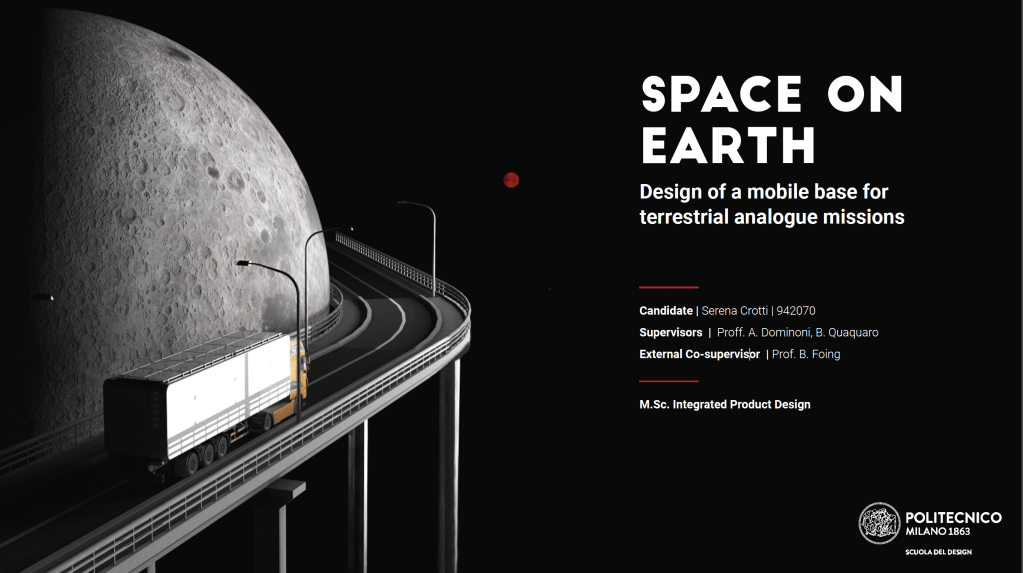
Multiverso Hab is a transportable habitat designed to conduct simulations of Space missions on Earth with ground-based teams of astronauts. These missions are called “analogue missions”. The project is therefore set in the context of Design for Space. The overall goal of design in this field is providing well-being to astronauts in the extreme and confined environment of Space modules. The project was developed under the academic supervision of professors Annalisa Dominoni and Benedetto Quaquaro (founders of the course Space4InspirAction at Polimi in collab with the European Space Agency) and Professor Bernard Foing (former ESA scientist, Principal Project Scientist for SMART-1 – the first European mission to the Moon, and also executive director of the International Lunar Exploration Working Group and EuroMoonMars). This project was conceived for the EuroMoonMars organisation, which for many years has been involved in organising Earth analogue missions in various locations around the world. It was an individual project.
RESEARCH CONTEXT: WHAT ARE OUR NEXT STEPS IN SPACE?
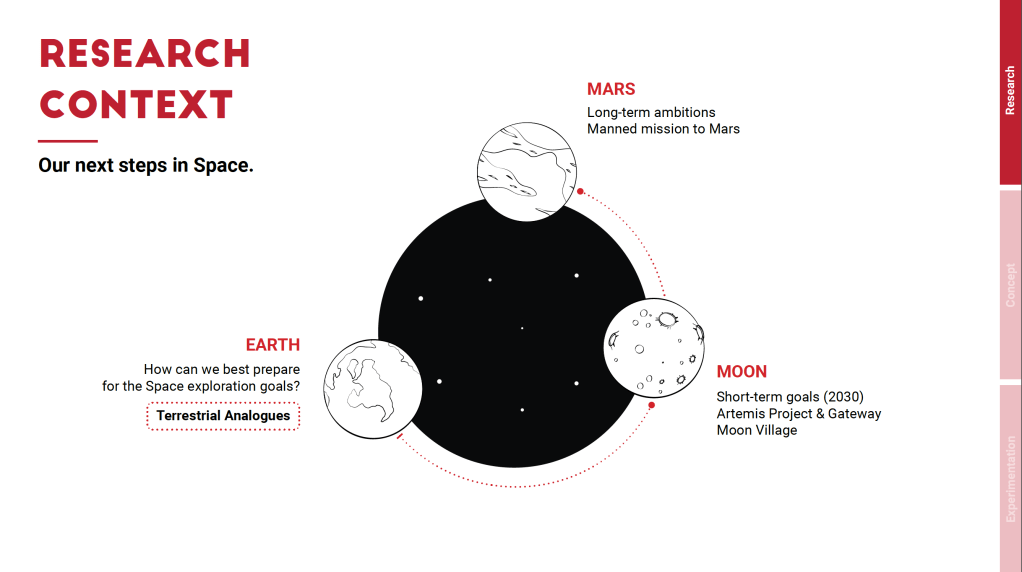
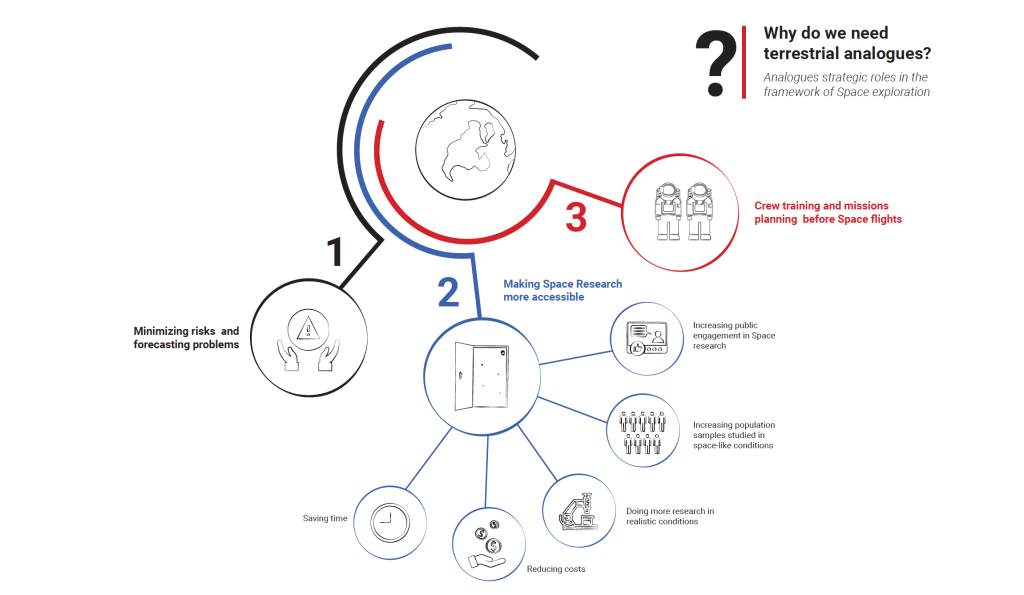
This work is framed within the context of research for Space Exploration. Space agencies have increasingly ambitious goals: returning to the Moon with a permanent settlement, the Moon Village, and landing the first men/women on Mars. In this scenario, the role of terrestrial preparatory activities, in particular space mission simulators, also called analogues, is crucial to increase the chances of mission success.
DESIGN FOR SPACE
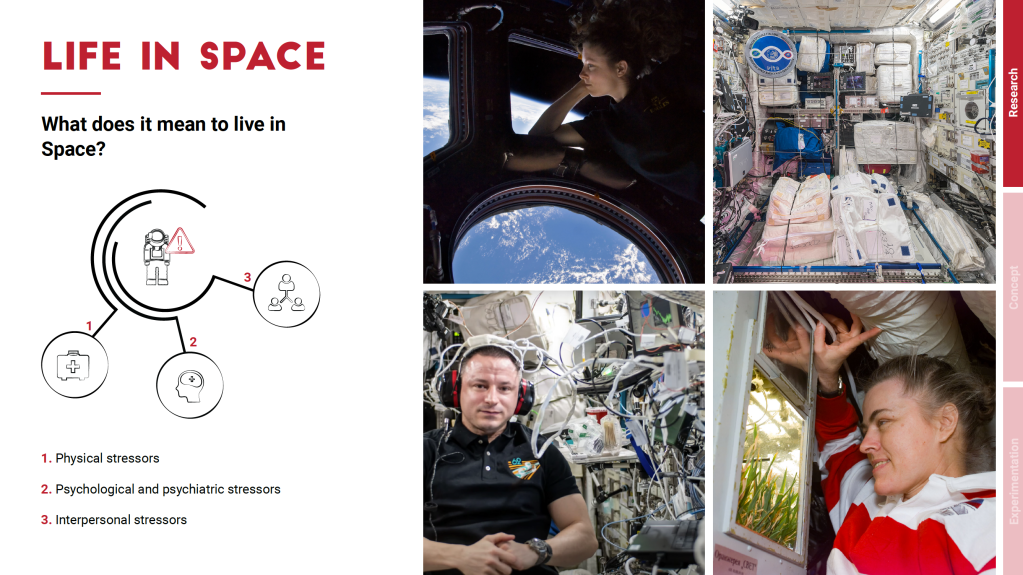
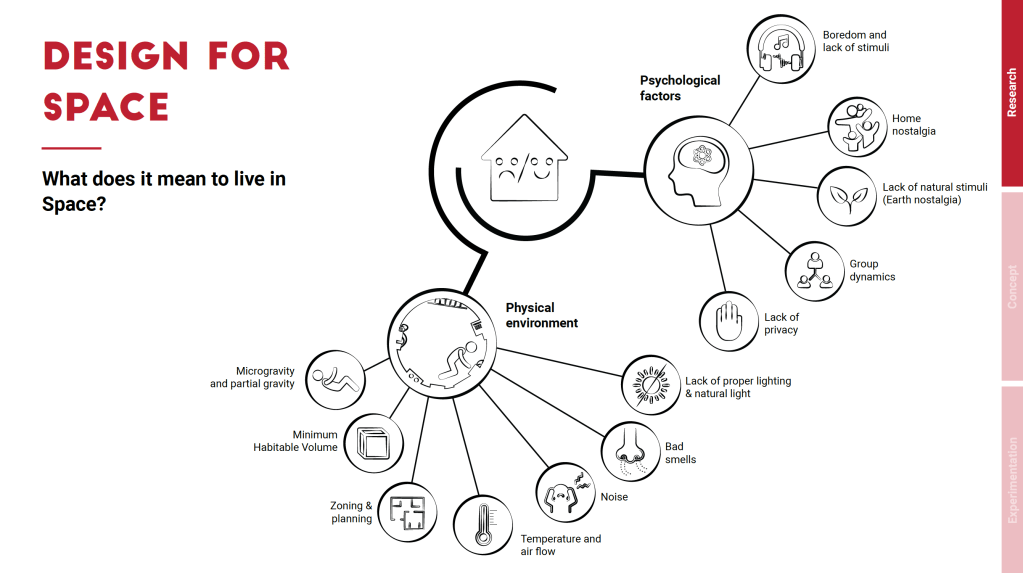
An analogue must simulate life in space, yet remaining on Earth. The research therefore first addressed the issue of the living conditions in Space. This particular setting exposes the astronaut to extreme stress conditions, which can be divided into three macro categories:
1. the physiological stress, given for example by microgravity
2. the psychological one, caused by living in confined environments, far from the Earth and in total dependence on equipment
3. the interpersonal one, linked to living with other crew members in the confined environment
An in-depth analysis of the typical stressors of spacecraft environments was conducted, with the user-astronaut at the centre, in order to identify design opportunities and thematic areas to be addressed in the design of the habitation unit for simulations.
TERRESTRIAL ANALOGUES: WHY DO WE NEED THEM?
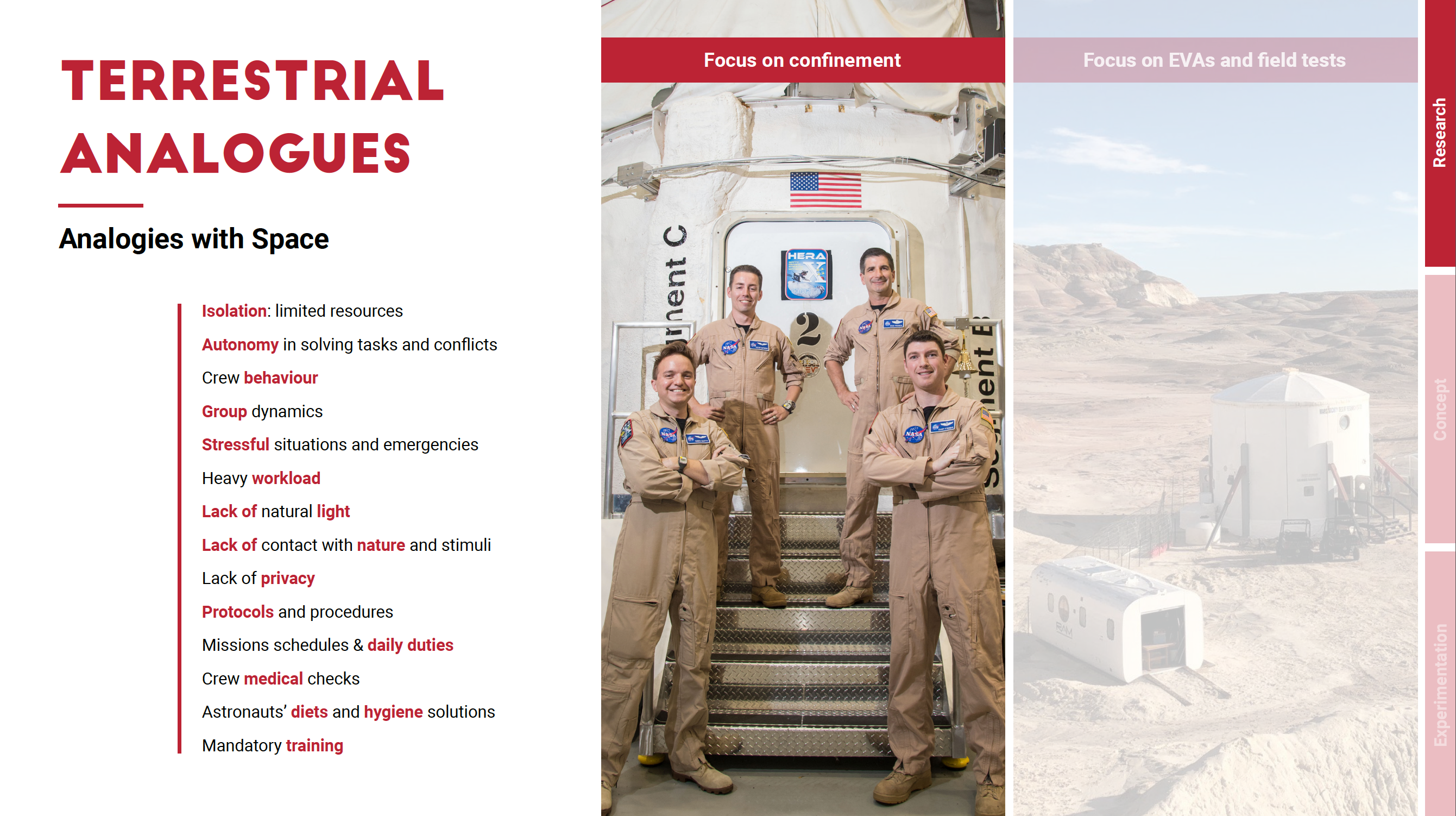
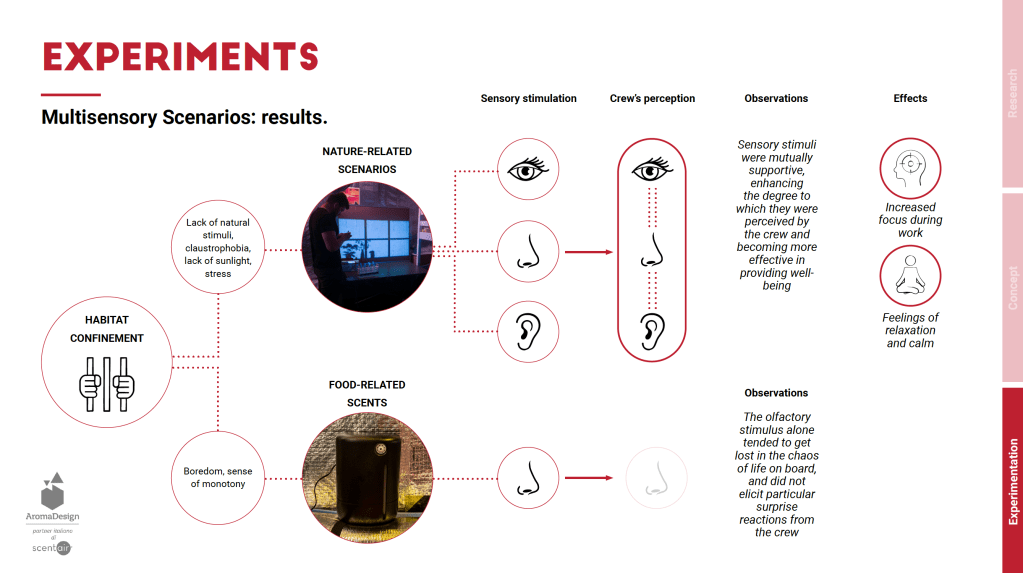
Multiverse Hab falls into the first type. In this kind of facilities, it is possible to simulate conditions of crew isolation, autonomous management of problems, seclusion conditions, for instance lack of natural stimuli and natural light; isolation. Typical routines of astronauts in space, hygienic and nutritional conditions can also be replicated.
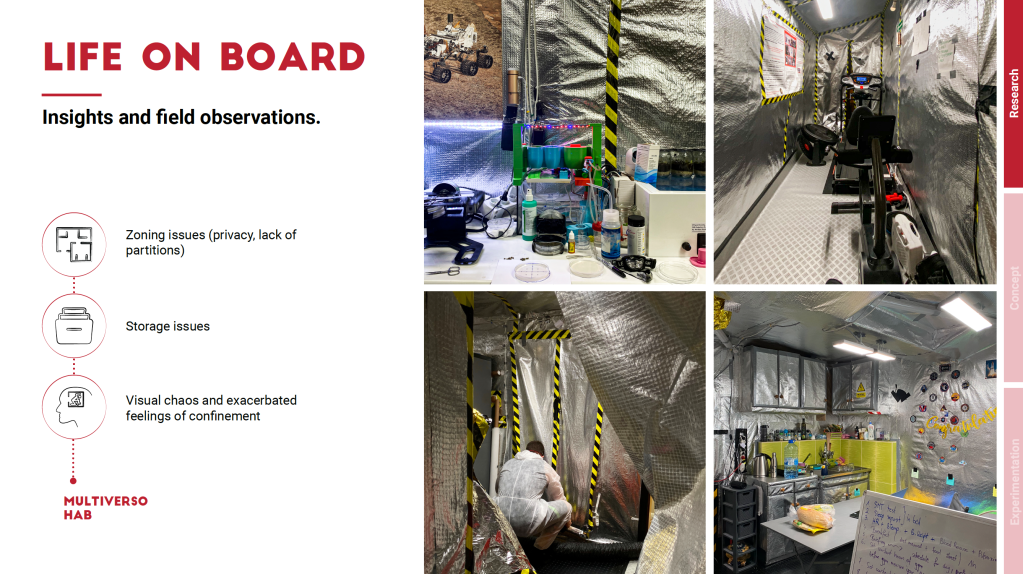
PUTTING MYSELF IN THE ASTRONAUTS’ SHOES: THE EMMPOL 8 ANALOGUE MISSION
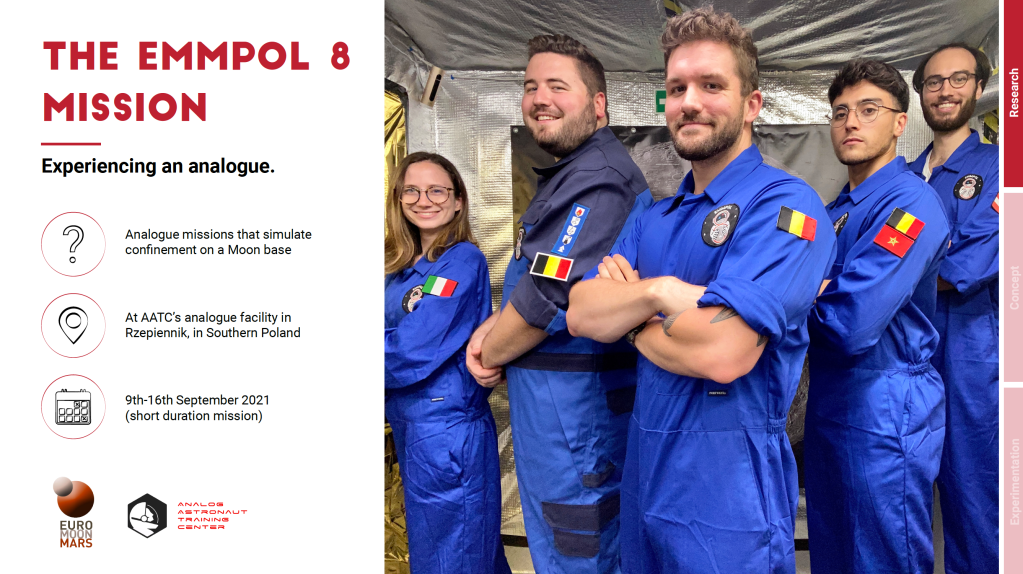
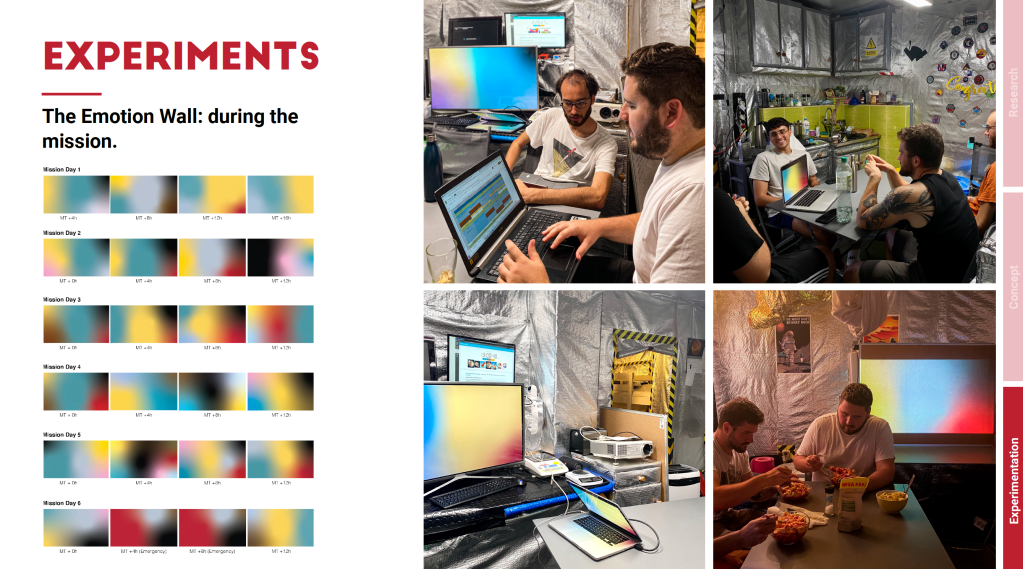
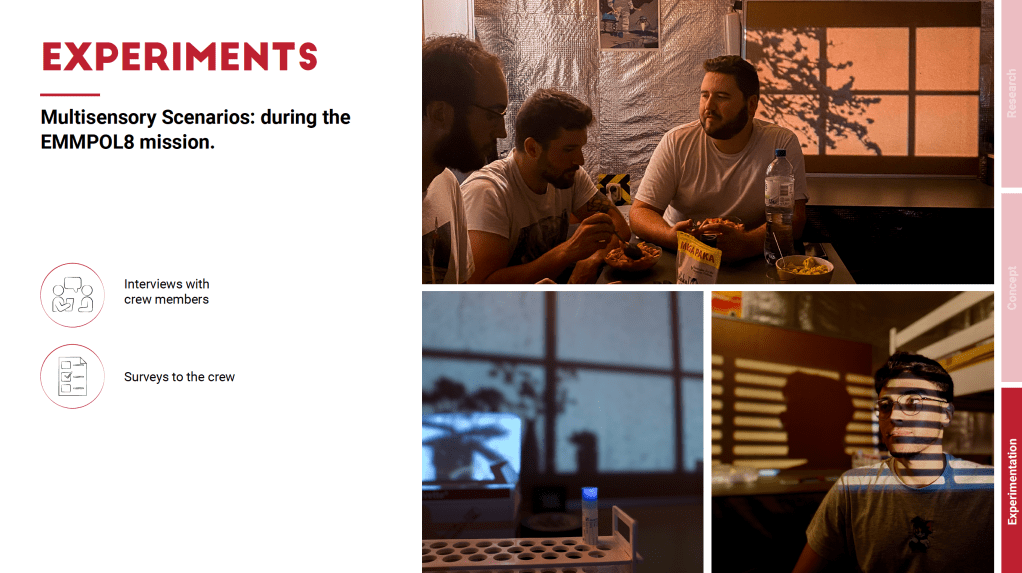
One approach followed in the research phase was to experience firsthand life aboard an analogue simulator. In particular, in September 2021 I had the opportunity to participate in a week-long analogue mission in total isolation, organized by EuroMoonMars with the Analog Astronaut Training Center in Poland. My official role was that of Vice-Commander and Communication Officer of the mission.
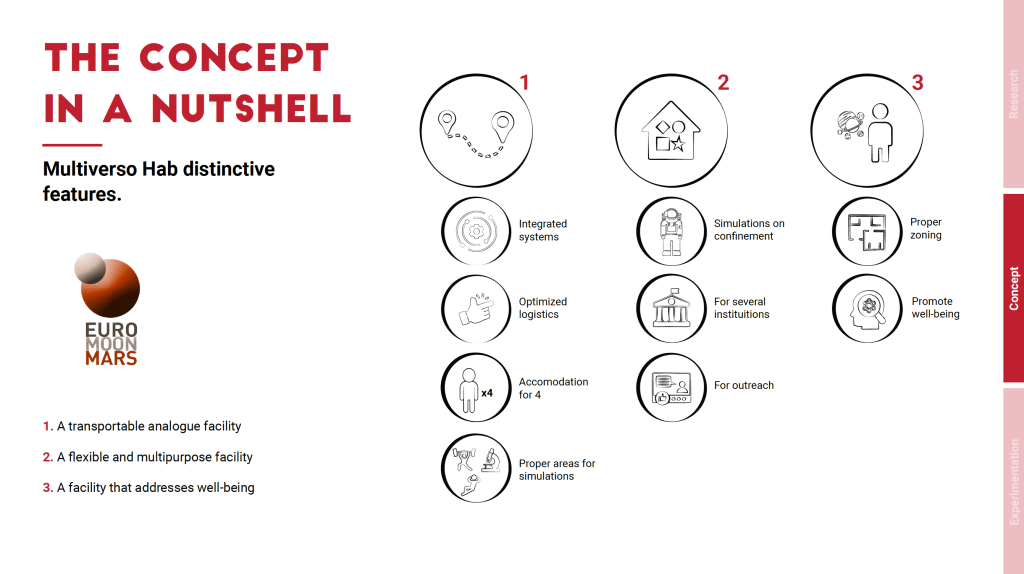
THE CONCEPT IN A NUTSHELL: MULTIVERSO HAB DISTINCTIVE FEATURES
As a result of the research phase, a set of design opportunities were identified that make Multiverso Hab a unique simulator. In an innovative way compared to existing analogues, it embraces the key concepts of transportability, transformability and astronaut comfort in the confined environment. In a landscape where analogues are attracting the interest of various research organisations, transportability can be an effective way to offer a wide range of scientific communities the opportunity to conduct experiments and simulations, without having to incur the cost and time required to build a purpose-built facility. Linked to transportability is flexibility of use: having a transportable simulator makes it possible to organise various activities on board, not only missions, but also outreach and activities open to the public. Finally, in view of missions of increasing duration, the need to put wellbeing at the centre of the design discourse has arisen, by thinking of innovative on-board solutions.
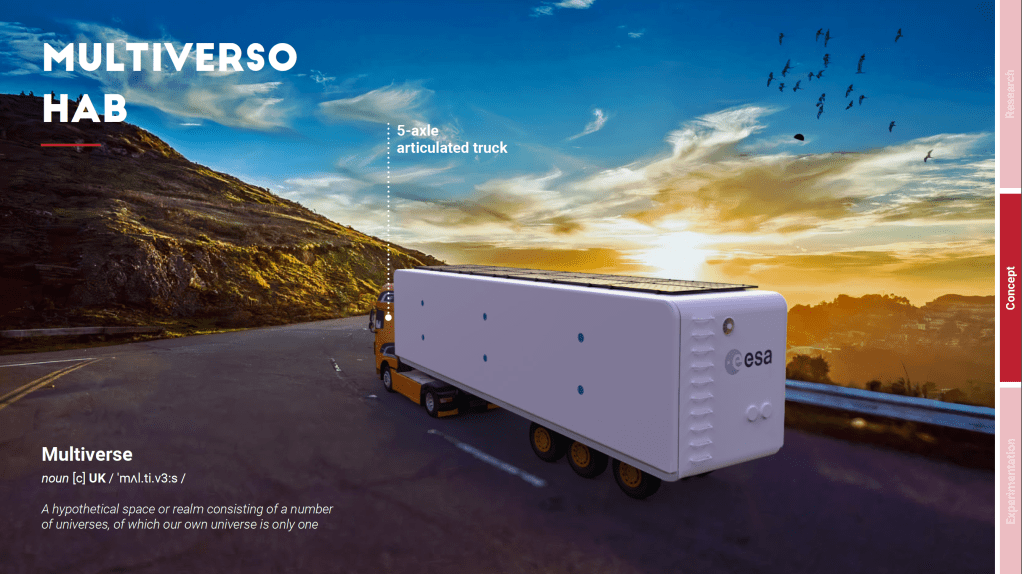
MULTIVERSO HAB: A TRANSPORTABLE SIMULATOR FOR SPACE MISSIONS ON EARTH
The module takes its name from the theory of the Multiverse, i.e. the hypothesis that more universes exist besides our own. The name is intended to emphasise the habitat’s versatility of use and transformability. When closed, its maximum dimensions are compatible with the standard load of a five-axle articulated truck.
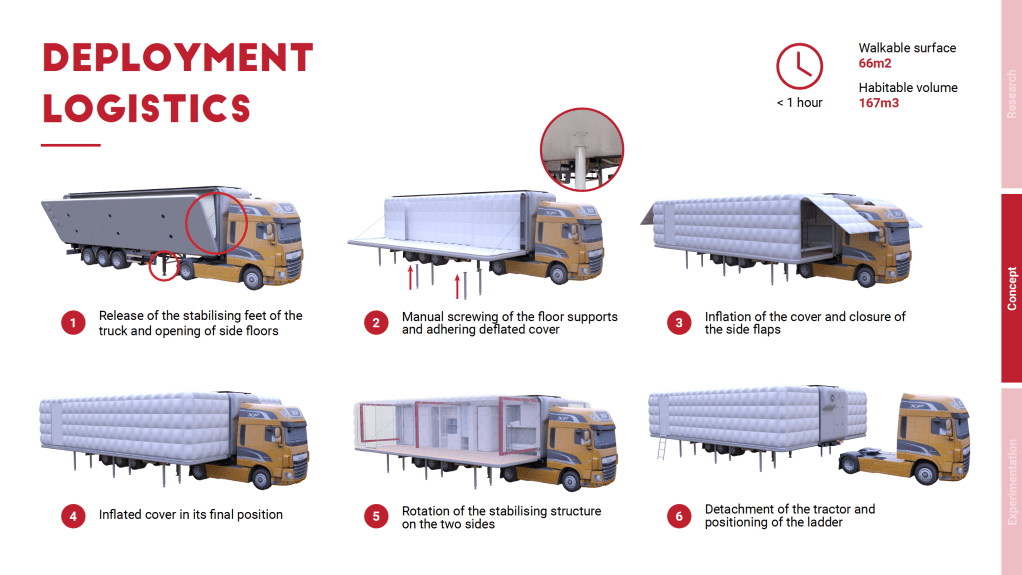
DEPLOYMENT LOGISTICS
Once on site, the transformation takes place and Multiverso Hab assumes the open configuration through a series of mostly automated operations, which take about an hour to complete. At the end of the procedures, the habitat assumes the open configuration, with a floor area of 66 square metres, and the truck can be detached. The habitat is ready to be used and no further logistical operations are required. All on-board systems are in fact integrated in the module and there is no need to connect the habitat to local grids. It is designed to make it possible to carry out simulations autonomously.
SCENARIOS OF USE: SPACE MISSIONS SIMULATIONS AND OUTREACH
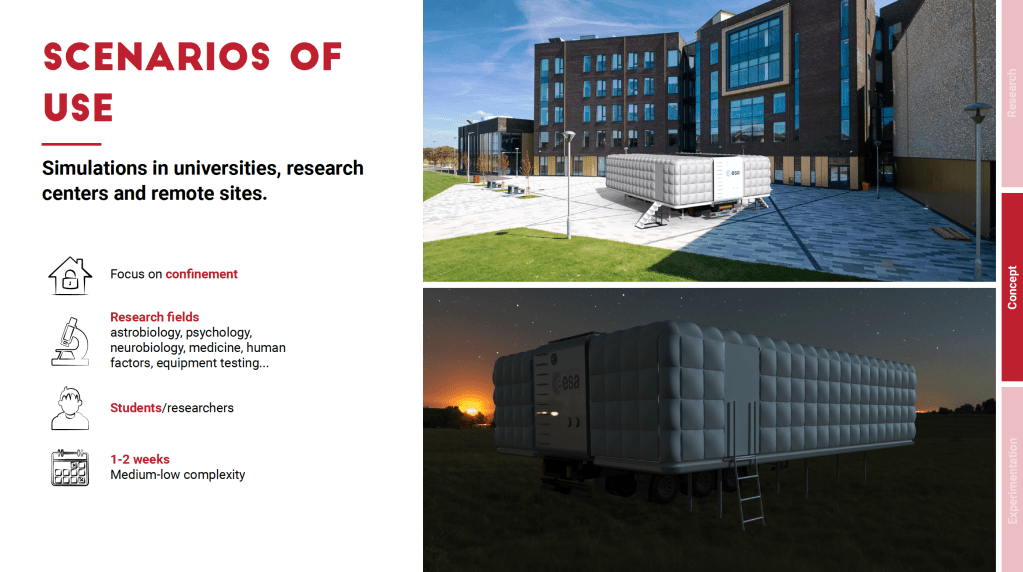
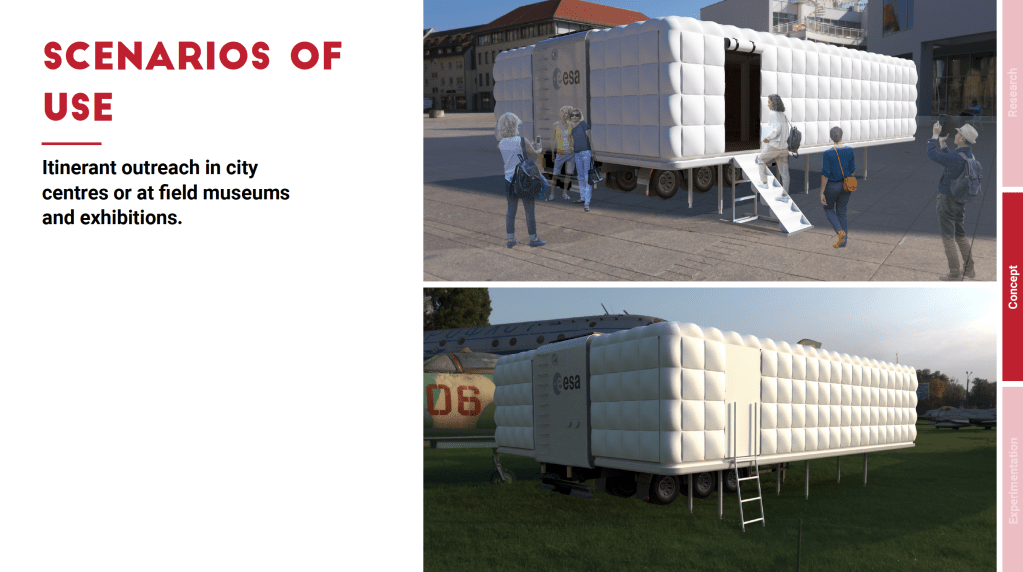
The habitat can be used either to conduct simulations within university hubs and research centres that require it, or in remote areas. The systems are optimised to make it autonomous for conducting simulations lasting up to 2 weeks, for 4 students/researchers. The second scenario is that of outreach. In this case, Multiverso Hab becomes a proper itinerant museum open to the public that wants to learn about the living conditions on board a space base.
MAIN STRUCTURE
From a structural point of view, the habitat has a supporting frame made of steel pillars and beams, in blue; attached to it on both sides is the stabilising structure that rotates with electric pistons, in yellow. In white is the inflatable structure, which is blown up thanks to two electric pumps integrated in the central module.

GETTING ON BOARD
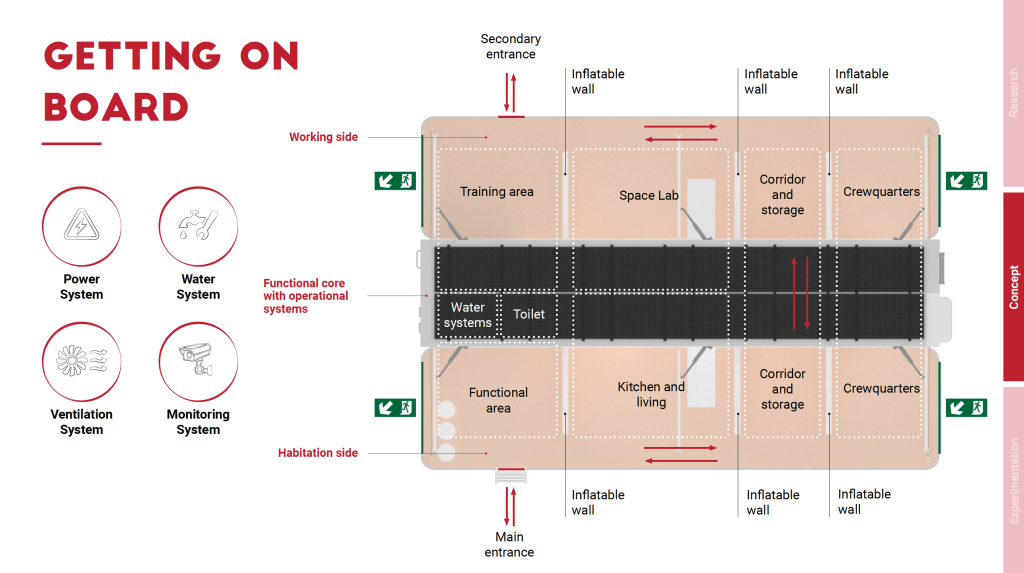
In the layout, the habitat is conceptually organised in three zones. In the centre is the functional core with the operating systems, optimised to allow autonomy for four people for a fortnight: electricity, water, ventilation and surveillance. Each of the main systems was envisaged on board at the concept level, thanks to consultancy with construction engineering firm AGM, which is based in Bergamo (Italy). The main components of the systems were also sized and located on board, with reference to commercially existing ones. On either side of the central unit are the living side, which is dedicated to the daily activities of the crew, and the working side, which is dedicated to the laboratory for conducting experiments on board. The final configuration is the result of in-depth reflections on zoning, aimed at meeting privacy requirements and improving life in the confined environment.
THE HABITATION SIDE
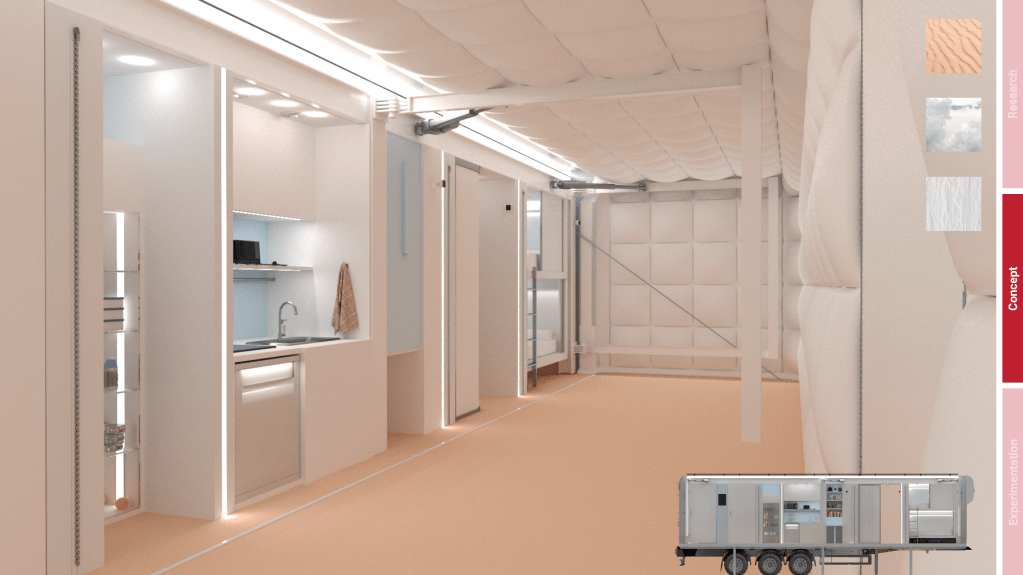
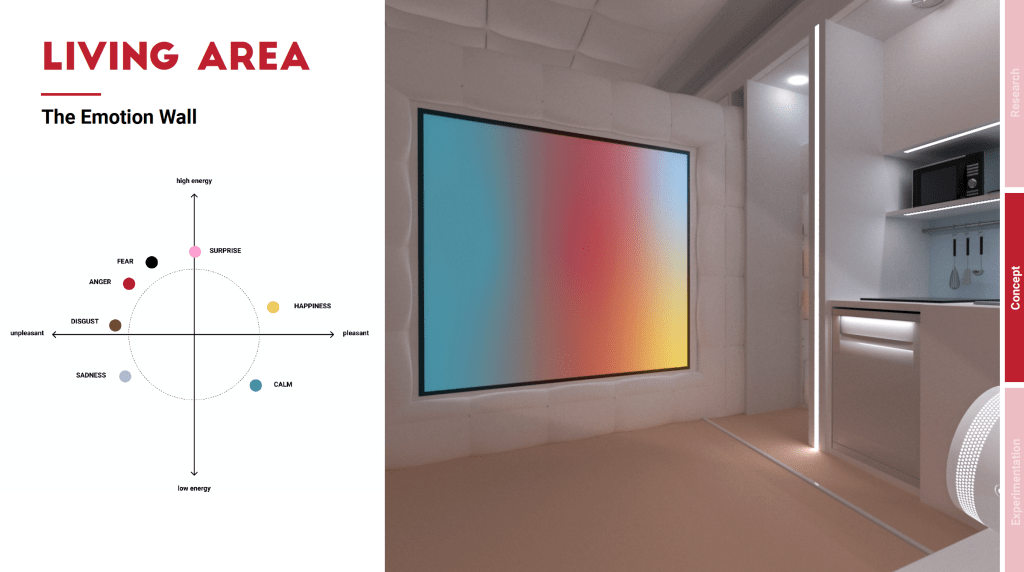
Here you can see the living side in its open-plan configuration. The colour palette was selected to create a pleasant and cosy environment; the colours are based on shades sampled from the natural world. The sky-blue hues applied to the vertical surfaces are intended to create the illusion of openings in the elevation, with the aim of reducing the sense of confinement. The decision was taken to refer to colours of the natural world, also known as “biophilic colours” (Kellert & Calabrese, 2015). Biophilic design reduces stress and enhances wellbeing (Browning et al., 2014). Biophilic colours are tones sampled from nature in different ways: extrapolated from the colour of the sky at different times of the day, from the tones of the sea, the ground or vegetation (Coulthard, 2020). Another important factor was the feeling of cosiness that was sought. In order to increase the sense of well-being, it was necessary that the crew did not feel immersed in an aseptic environment. This criterion, however, was accompanied by the need to create an environment that would also convey a “space-like” mood. The question was therefore: how can a feeling of intimacy be combined with the space imagery?
THE WORKING SIDE
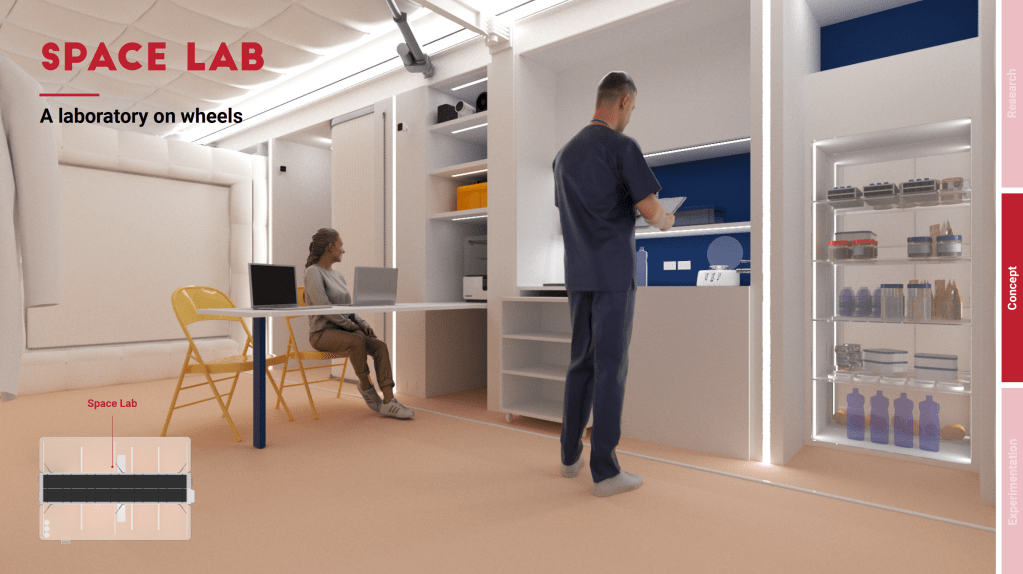
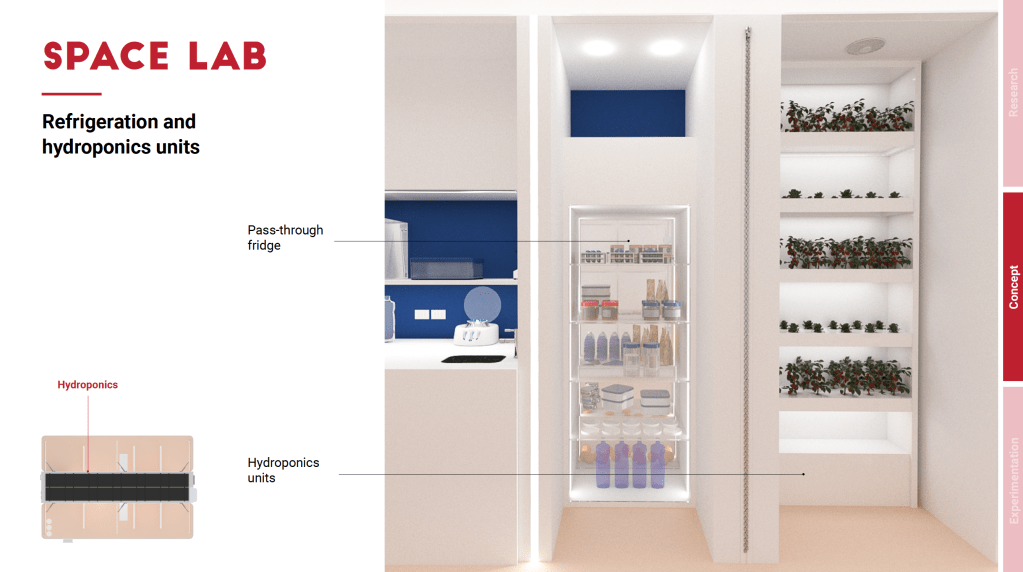
On the working side too, the colour palette was selected to create a cosy ambience, but midnight blue was chosen to communicate a more space-like aesthetic. Here is in fact the Space Lab.

FLEXIBLE SPACES
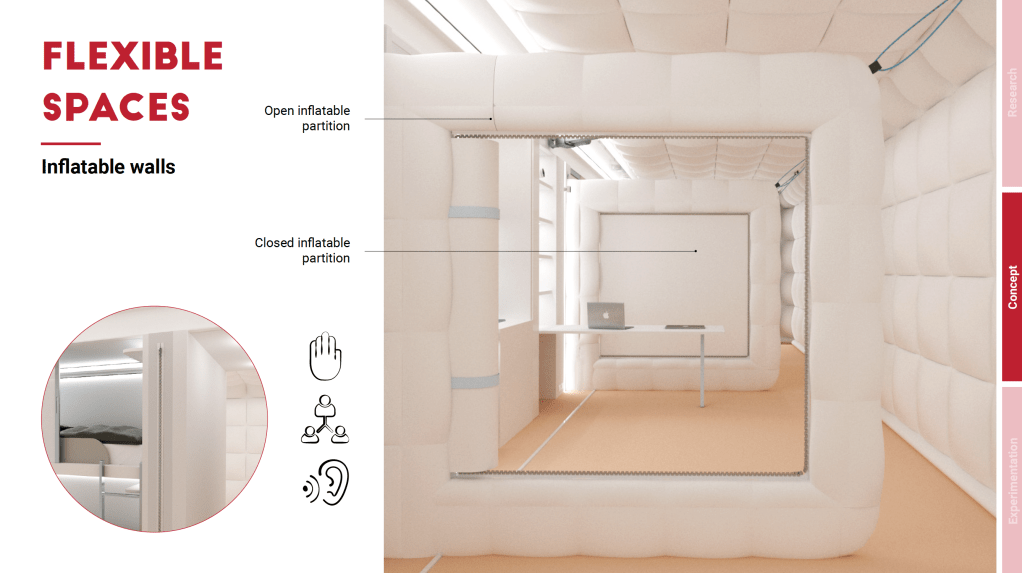
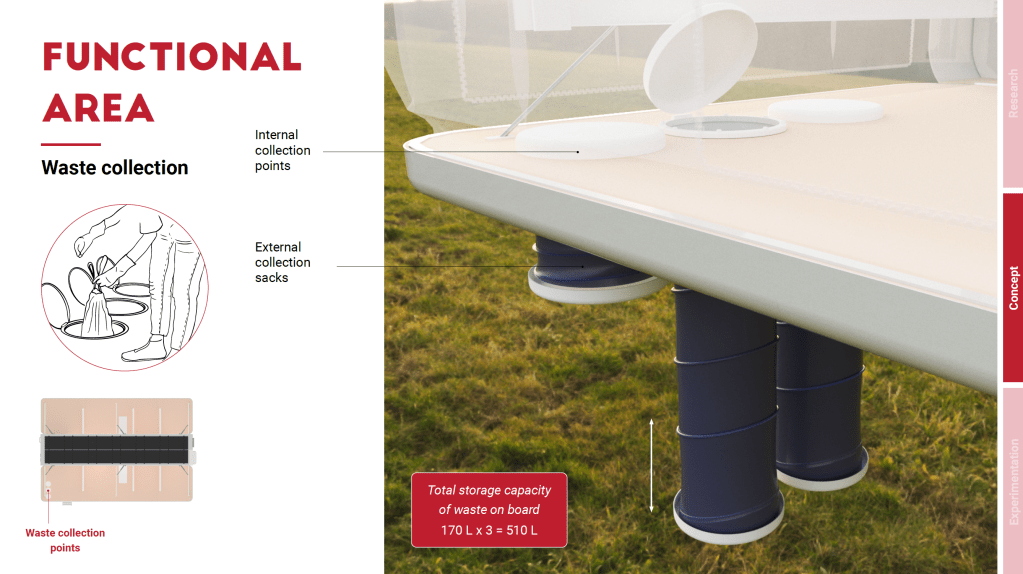
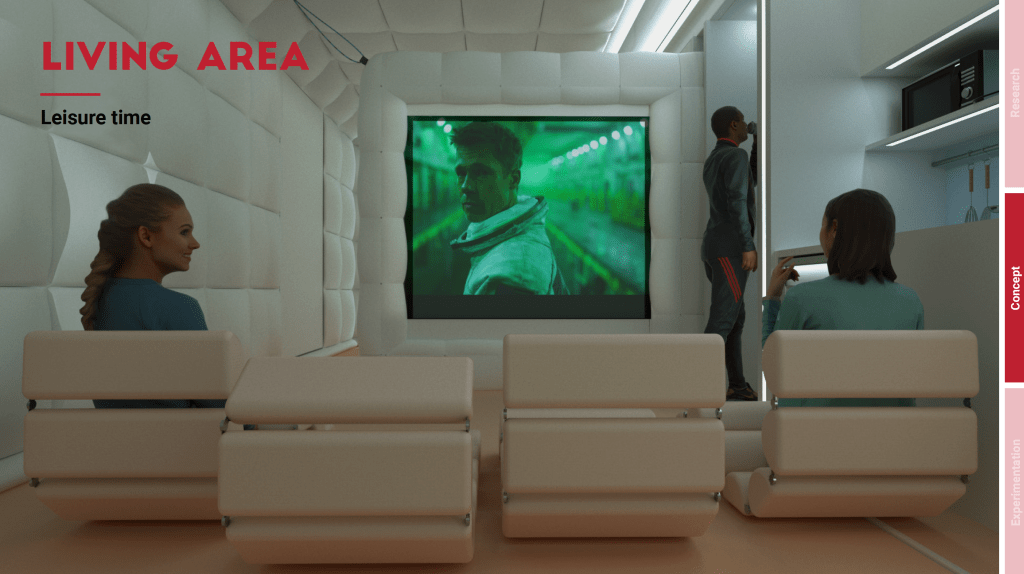
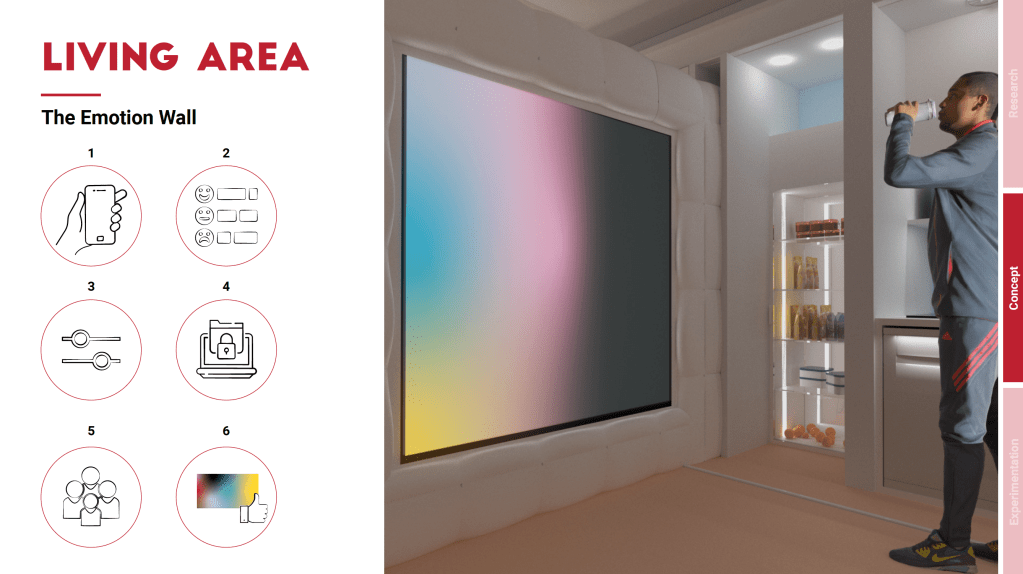
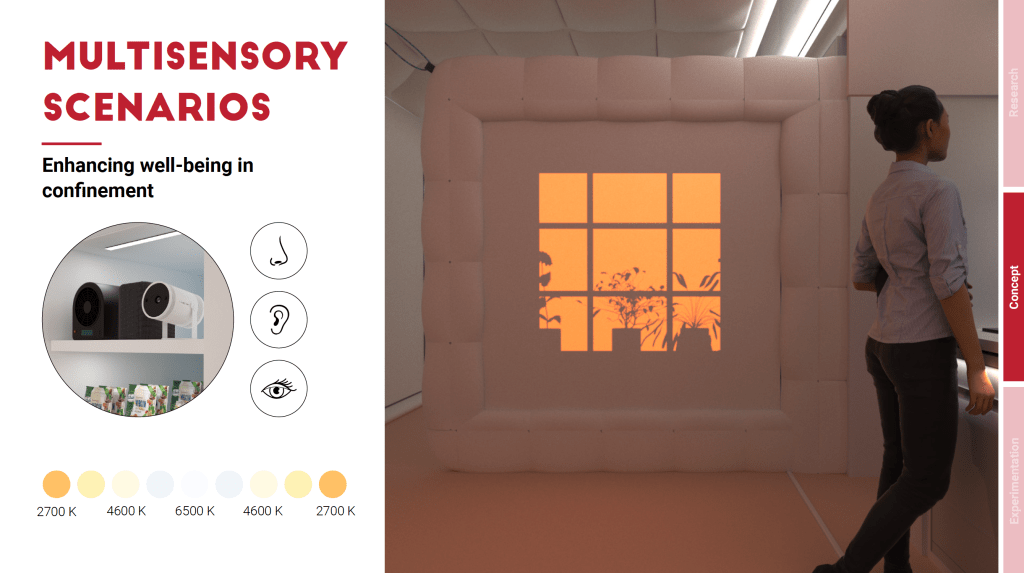
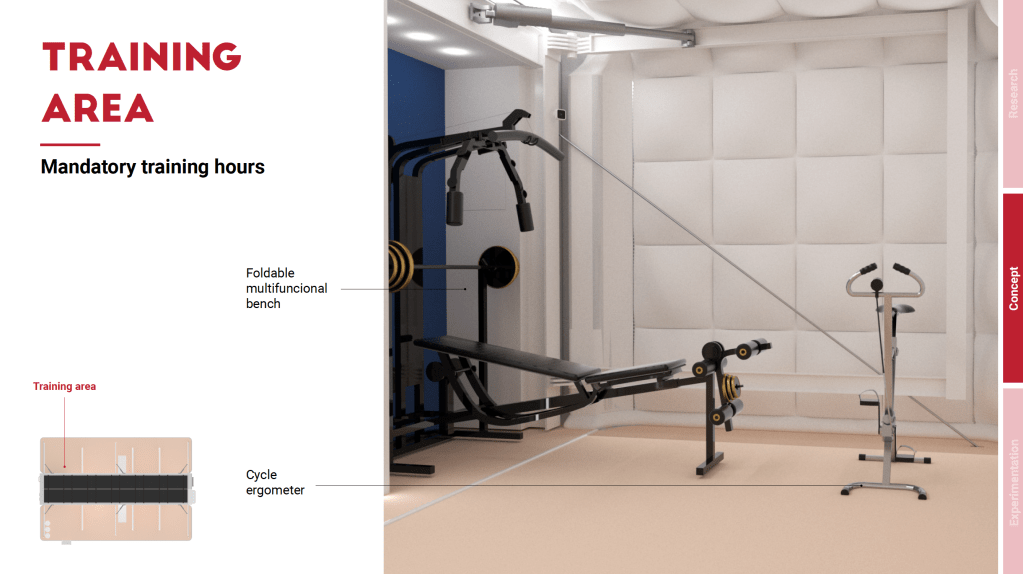
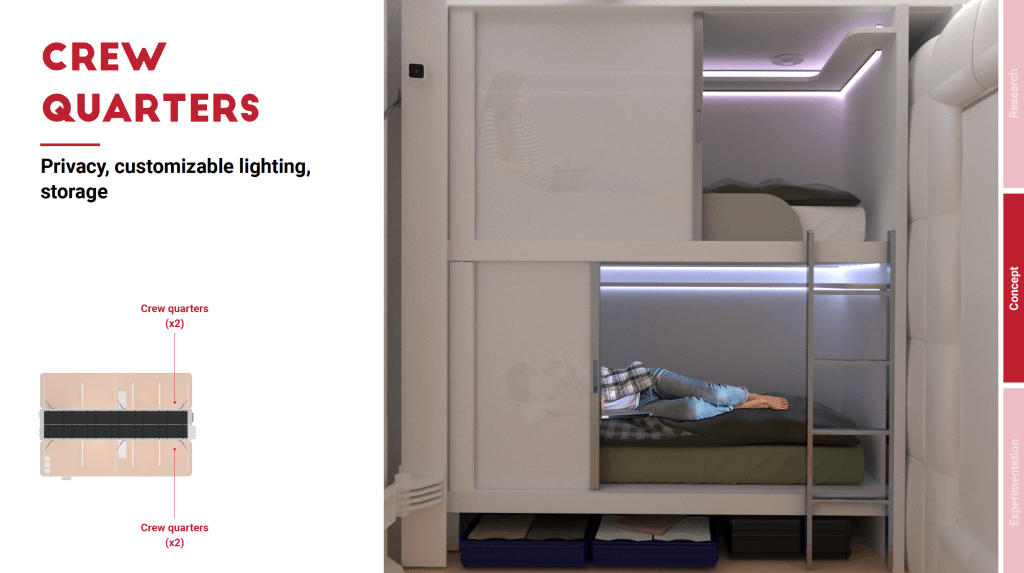
Thanks to a system of inflatable walls integrated into the central module, it is possible to divide up the interior areas, thereby creating functional zones of greater intimacy and privacy, while also promoting acoustic insulation of the different rooms. In this way, both communal areas, open spaces, and individual spaces for various activities can be obtained in the confined environment. Following are the main functional areas that have been provided on board.



MULTIVERSO HAB FOR ITINERANT OUTREACH
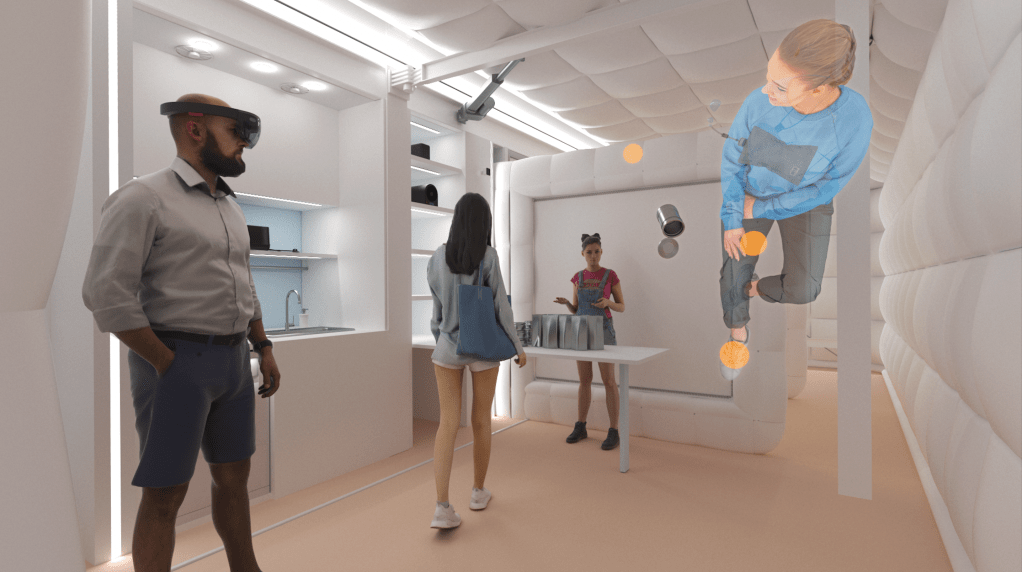
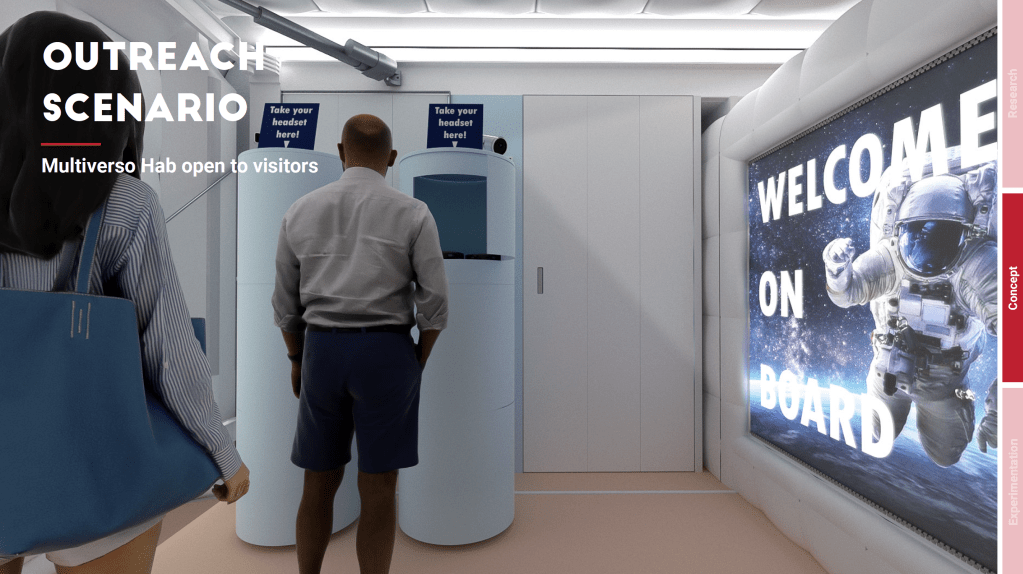
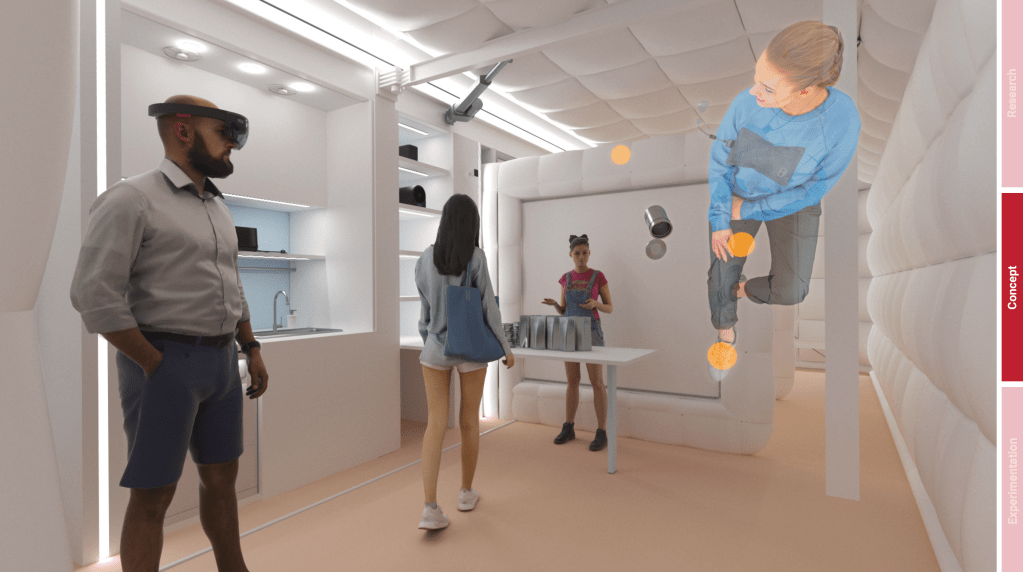
Multiverse Hab transforms into a unique experiential museum when it is opened to the public for outreach purposes. The internal distribution of zoning and inflatable divisions is designed to allow visitors to efficiently manage their internal path. While on board, they are invited to wear Microsoft Hololens visors as they tour through the various rooms of the Space base. Visors allow visitors to view realistic astronaut figures in microgravity in the different environments. These explain how daily activities, for example, the eating of meals, take place in a real space base. Visitors can then enjoy different experiences in the various rooms. In the kitchen, for example, they can taste space food, which is now commercialized by NASA for the Space enthusiasts.
CURIOUS TO KNOW MORE ABOUT THIS PROJECT?
Here you can find some extra contents 🙂
Crotti, S., Dominoni, A., Foing, B., Quaquaro, B., Reymen, B., Schlarmann, L., Zyn, A.E., Dierckx, J. and Kołodziejczyk, A. (2022). Enhancing well-being aboard confined Space environments: the role of Design research in the EMMPOL 8 analogue mission. doi:10.5194/egusphere-egu22-5974.
 SERENA CROTTI PORTFOLIO